
White Paper
Reaction Injection Molding Design Guide
An introduction to our RIM design processes
.
Overview
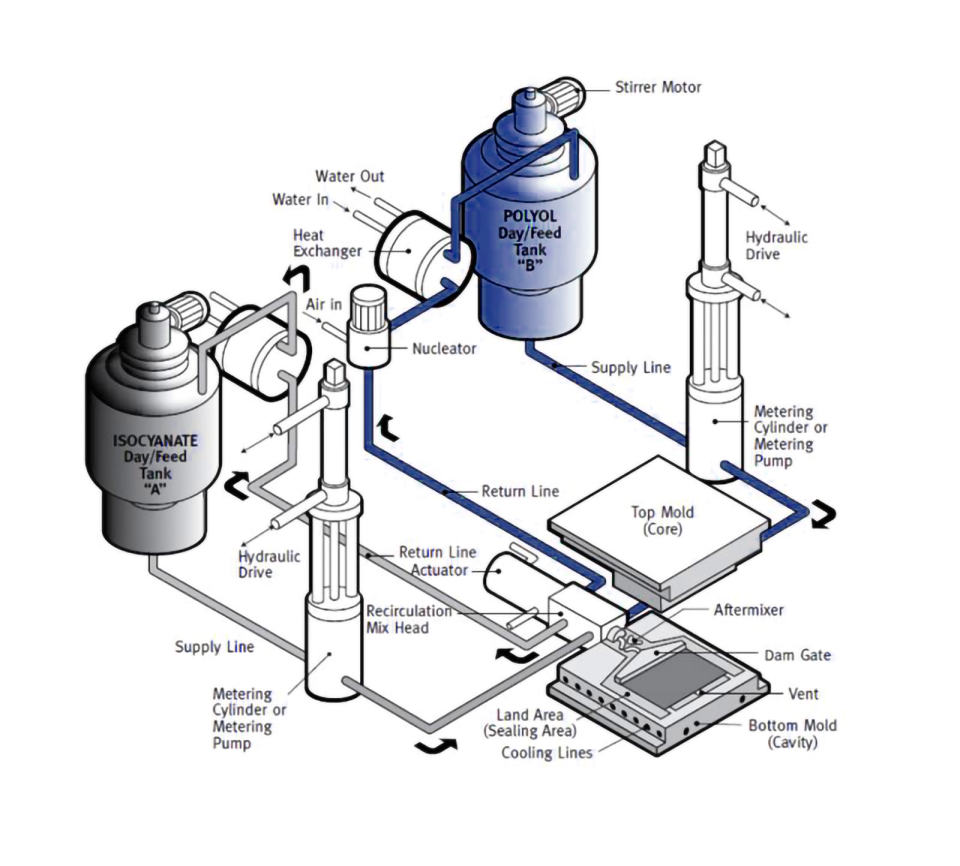
Reaction Injection Molding (RIM) is a highly versatile manufacturing process that combines elements of multiple molding technologies to deliver unique performance and design advantages. One of RIM’s key benefits is the ability to produce parts with variable wall thicknesses while maintaining excellent surface quality, something that is often difficult to achieve with traditional thermoplastic injection molding.
RIM also allows for the encapsulation of a wide range of materials, including sheet metal, threaded inserts, wood, textiles, and structural reinforcements. Because the process operates at lower pressures and temperatures, large and complex parts can be molded using lower-cost tooling compared to conventional injection molding.
This guide serves as a general reference for designing parts using foamed, structural rigid RIM materials. While these guidelines represent proven best practices, they are not absolute rules. We strongly recommend engaging Fi’s engineering team early in the design process to ensure optimal manufacturability, performance, and cost efficiency.
Recommended Tolerances
Understanding achievable tolerances early in the design phase is critical. In RIM, tolerances are influenced by part size, geometry, and complexity. Features such as ribs, bosses, holes, draft angles, and wall thickness variation all affect dimensional control.
General tolerance guidelines include:
- Parts under 12 inches in length typically achieve linear tolerances of ±0.020 in, depending on geometry.
- Parts between 12 and 60 inches in length generally fall within 0.0015–0.002 in per inch.
- Holes up to 3 inches in diameter can typically be held to ±0.010 in.
Texture
RIM materials replicate mold details exceptionally well, making them ideal for textured and patterned surfaces. Aluminum tooling can be photo-etched to create thousands of available textures, ranging from subtle matte finishes to aggressive patterns. Parts may incorporate a single texture, multiple textures, or a combination of textured and polished surfaces.
Because textured surfaces require additional draft for proper release, texture selection should be considered early in the design process.
Draft guidelines for textured surfaces:
- For every 0.001 in of texture depth, add 1–1.5 degrees of draft.
- Typical texture depths range from 0.002–0.0045 in, resulting in draft requirements of approximately 2–6.75 degrees on vertical walls.
- Draft requirements may be reduced depending on material selection and part geometry.
Color
Color can be incorporated into RIM parts using several methods:
- Pigmented raw materials (color throughout the part)
- Post-mold painting
- In-mold coating (IMC)
The most common approaches are IMC and post painting. Both provide durable color and UV resistance; however, IMC delivers these benefits in a single, cost-effective process with superior adhesion and no additional surface preparation. IMC is often the preferred solution for high-quality cosmetic finishes.
Nominal Wall Thickness
RIM offers significantly more design freedom than traditional injection molding, particularly when using foamed systems that are less prone to sink.
Guidelines include:
- Localized wall thicknesses may range from 1/8 in to 1 in.
- Typical nominal wall thicknesses fall between 3/16 in and 0.5 in.
- Changes in thickness should generally remain below a 2:1 ratio to avoid flow issues and trapped air.
While thicker sections are possible, they increase cure time and production cost. Large thickness variations may also lead to uneven shrinkage, read-through, warpage, or thermal splitting. When additional stiffness is required, over-molding structural inserts is often more effective than increasing wall thickness.
Parting, Lines, Venting & Gating
The parting line is a critical design element that influences gating, venting, draft strategy, and part aesthetics.
Best practices include:
- Position the parting line as high as possible to promote effective venting.
- When this is not feasible, a stripper plate may be required to create a secondary vented parting line.
- Maintain a sharp parting edge—radiused edges can restrict venting and cause pinhole voids.
- Textured or IMC-coated parts require special consideration, as coating both core and cavity surfaces can reduce venting efficiency.
Most RIM parts are filled using edge gates:
- Typical gate lengths range from ~2 inches for small parts to 8 inches or more for larger components.
- Straight gate edges are preferred for uniform filling and clean de-gating, though curved gates may be used when necessary.
Ribs
Ribs primarily add stiffness and improve venting by providing airflow paths during filling.
Design recommendations:
- Add fillets at rib roots to reduce stress and improve flow (1/32–1/8 in typical).
- Radius rib tops to aid tool machining and maintenance.
- Apply 1–2 degrees of draft per side.
- For cosmetic surfaces, rib width (including radii) should not exceed nominal wall thickness to minimize read-through.

Bosses
Bosses are commonly used for alignment, attachment, and spacing.
Guidelines include:
- Apply 1–2 degrees of draft.
- Core bosses to a depth equal to nominal wall thickness using a tapered pin.
- Add fillets at the base (1/32–1/8 in typical) to reduce stress concentrations.
- For threaded inserts, maintain a minimum wall thickness of 3/16 in at the top of the cored hole.
- To prevent cosmetic read-through, boss bases should not exceed nominal wall thickness when aesthetics are critical.

Non-Draw Features & Undercuts
Non-draw features such as slots and side holes are best created using hand-loaded inserts or post-machining. Movable slides are avoided when possible due to maintenance requirements and visible parting lines.
Undercuts can be molded but significantly increase tooling and part cost. When unavoidable, removable inserts or opposing pins are preferred.

Draft
All molded features require draft to enable part release.
General guidelines:
- Smooth surfaces typically require 1–2 degrees per side, depending on depth.
- Textured surfaces often require 3–6.5 degrees, increasing with feature height.
- Interior draft often exceeds exterior draft to encourage part retention in the cavity.
- Ribs and bosses typically require 1–3 degrees per side.
- Cored holes require 2–3 degrees, or 1.5 degrees when used for threaded inserts.
Radii & Fillets
Radii improve part strength, material flow, and tool manufacturability.
Typical guidelines:
- External radii: 0.125–0.25 in for 0.25 in wall thickness
- Internal fillets: 1/32–1/8 in
- Rib and boss fillets should maintain a ≤1:1 ratio between root width and nominal wall thickness to minimize sink.
Threaded Inserts
Threaded inserts are typically post-installed for cost efficiency and flexibility. Molded-in holes provide higher pull-out strength due to the dense surface skin formed during molding.
Fi supports both metric and standard inserts from suppliers such as Stafast and Yardley.
INDIAN GAMING TRADE SHOW
We’ll be attending IGA 2026, Apirl 1st – 2nd | Booth 2421
We Understand Your Challenges
With over 100 years of combined experience, our team brings deep technical knowledge and practical design insight to every project. Whether you’re in the early concept phase or refining specifications for production, we work collaboratively to understand your requirements, identify efficiencies, and develop solutions that align with your timeline.
Share a few details with us using the form, and our team will follow up to explore how we can support your goals with responsive communication, thoughtful engineering, and dependable execution.